Friday, June 29, 2018

Raise the Damn Minimum Wage


This might not be topical, but I think it’s important.

The real value of the US federal minimum wage peaked in 1968 at $8.60 in 2018 dollars (using a chained CPI - using a traditional CPI measure its closer to $11.50). If you were a naïve optimist, this would be surprising, since the United States is much richer today than it was in 1968, with GDP per person, productivity, and average wages all having grown significantly since then.

In 1968 the US had a (real) GDP per person of $23,000; that’s comparable to modern day Uruguay, Romania, Croatia, and Panama. Today our GPD per person is $53,000. That means that our society has more than twice the amount of resources per person we did in 50 years ago – though it sure as hell doesn’t feel like it.

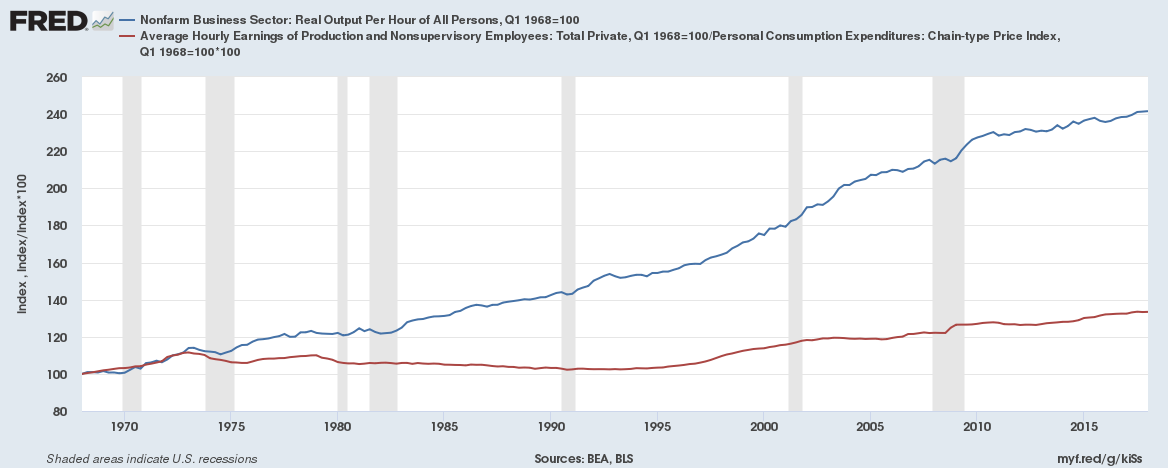
Over the past 50 years, average wages in the US have increased significantly, while the federal minimum has increased, much more slowly.

In 1968, the minimum wage was about half the average hourly wage. In 2018 the minimum is less than a third. Note that this data excludes supervisory workers, so underestimates the growing divergence.

Productivity has also increased since 1968, with output per hour being 2.4 times what is was in 1968. Meanwhile, average hourly earnings are only 1.4 times what they were 50 years ago.
So what’s my point here? That raising the damn minimum wage is hardly the end of the fucking world, and people shouldn’t fucking panic about it.

Assuming perfectly competitive markets (stop laughing!), somebody who was paid $8.60 an hour in 1968 produced at least $8.60 of value an hour in 1968. I’ll be conservative and say productivity growth has been slower for minimum wage work than work on average, so their productivity has only increased by half as much – a mere 70%. Then an hour that created $8.60 of value 50 years ago should create $14.72 today.

Or we could take another track, and ask what the minimum would be if we tried to keep it at half the average. Since hourly average wages in 2018 are 22.60, the minimum wage would be $11.30.

Thursday, June 21, 2018

Autism and Egalitarianism

I am a very high-functioning autistic. What that means is that I go through life oblivious to what you find obvious.

You see, dear reader, to me it is as if the people around me are dancing to some silent music and I, I have no choice but to try to dance with them.

So I try very much to be my best self without regard for how others think of me. This is not courage, but necessity. Were I to be concerned with others opinions I would be paralyzed by fear and doubt.
For only with the greatest of difficulty  can I come to know those opinions unless I explicitly ask them - and even then, would I hear the truth?

"Fitting in" for me is thus a fools errand. Better not to try, and be my best strange self. I have some coping mechanisms to help me function in society.

First, I use  intellect when others would use  instinct. Happily, I'm intelligent enough for this to work, but deciphering social relations intellectually does not help me participate in real-time interactions. For that, I have other strategies. I am kind and generous, I try to be polite and when I do give offense I seek to make it clear that there is no malice.

Essentially, I try to be a nice, likable person, so that people will be patient with me, interpret my words and actions generously, and generally put up with my excentriccities. And I am honest. An effective lie is only effective if I can juggle who knows who, who "knows" what, and what people want to believe. Thus keeping up even a small lie is for me very burdensome. Or to quote Mark Twain: "If you tell the truth, you don't have to remember anything".

How does this inform my politics?

Well for one, I'm an egalitarian. Now, I could offer various moral or practical arguments for this position. But I won't. Because fundamentally, my egalitarianism is an instinct born of my autism.

How am I supposed to move through the dance-floor if there is not single tune music and dance, but different musics and different dances that change depending on, say, relative social status?

I cannot.

The present world is an unequal world.  It tries to force me to navigate social hierarchies and power relations, relationships between superior and inferior, to divine and then flatter the sensibilities of the powerful.

I rebel against this world. It is cognitively difficulty for me. I long for a world where it is enough to enough for me to treat people as people, with kindness and generousness, and none find that confusing or remarkable.

That world I could bear.

Monday, June 18, 2018

How Automation Will Change Management


So, for my job I do quite a bit of reading about “the future of work” and I have some opinions about how some emerging management challenges that future implies. Now the key feature of work in this future, which has been coming at us, really, since the start of the industrial revolution, is automation.  Continual progress in labor-saving devices, increasing productivity, allowing us to all enjoy a higher standard of living (at least in the long-run). And the ultimate in saving labor, of course, is automation, performing a task without any human input at all. This has been the trend since steam-power replaced muscle power. As time goes on, the easiest jobs to automate are automated away, and humans do more work that’s difficult or impossible to automate.

What’s easy to automate? Machines excel at routine and predictable tasks – anything that can be fully described in formal, logical, precise terms (“if this do that”) or are totally repetitive (“every 1.74 seconds swing downward with between 1000 and 1050 kiloNewtons of force) is, bluntly, a job perfectly suited for machines – and a job that will be automated away as soon as economical. But sorting good art from bad, understanding spoken language, driving a car – any sort of work that might at any point require a modicum of actual thought (which is quite a bit of “unskilled labor” in the service sector) is difficult or impossible to automate completely. Answering a question like “is this a good investment” is something only a human can do, even as that human uses (hopefully!) a variety of sophisticated machines to help them make that decision.

Why is all this a problem for management? Because the work that’s being automated away is also the work that’s easiest to manage. Evaluating performance is easy for predictable and routine tasks, observing effort is straightforward when the work takes place almost entirely outside a worker’s head. Traditional management techniques and organizational structures are well suited to incentivizing effort (using Motivation 1.0 and 2.0, for those of you who’ve read a certain book) and evaluating performance.

But increasingly, more and more work will take involve complicated tasks that are costly or difficult to monitor, and more of that work will take place inside people’s heads. This isn’t an insurmountable problem, but managers will have to lean increasingly on intrinsic motivation (Motivation 3.0) in order to accommodate this. And bluntly, I don’t think business leaders (or at least American business leaders) are able or willing to deal with this problem. Grappling with this problem requires a (in the American context) radical rethink of employer-employee relations; conceiving of an employment relationship a social as well as economic relationship. The fundamental human in human relationships is reciprocity – why should workers be loyal to your company and emotionally invested in its success, if the company doesn’t feel the same way about them?

The alternative response is for management to spend whatever it takes on monitoring in order to 
avoid giving up any sort of control over workers and the workplace – even if it would be costlier. 

Hopefully profits are more important to capitalists than power.

Wednesday, May 30, 2018

When is intrinsic motivation bad?


Intrinsic motivation – the desire to do a thing for its own sake – is often regarded as the ideal motivation in the context of designing incentive structures. But there are some cases when a reliance on intrinsic motivation leads to adverse selection.

Consider policing. How many cops are sociopaths? The rate in the general population is about 4%. If police were representative a naïve estimate might be that 4% police are sociopaths. But police are not drawn at random from the population – people choose to be police. This has interesting implications.

Suppose police operate under “low-powered” incentives, thus intrinsic motivation is a larger component of why people choose to become police. This could be desirable if the effort exerted by police is difficult to monitor, thinking along the lines of “we trust police to try and catch bad guys even when they aren’t monitored, because police actually want to catch bad guys”. And we might believe that they want that because if they were “in it for the money” i.e. not (at all, there are degrees) intrinsically motivated they wouldn’t have chosen a career in law enforcement in the first place.
The problem is that low-powered incentives can select for intrinsic motivation, but not for particular kinds of intrinsic motivations. You might want to become a cop because you want to serve your community and keep people safe – or you might want a cop because you want to be able to beat, harass, and bully people with impunity. That is to say, you’re a sociopath sitting pretty in the middle of the “dark triad” of narcissism, machiavellianism, and sadism and despite low-powered incentives would so enjoy abusing others that you do the work anyway.

What can you do about this adverse selection problem? If you don’t want to throw the baby out with the bathwater (so to speak) and keep selecting for (public-spirited) intrinsically motivated cops by using low-powered incentives then you need effective and rigorous screening and accountability measures to weed out those who want to be cops for the wrong reasons. If you can’t or won’t do that, then you need to consider whether it would be worth it (or even possible) to switch to “high-powered” incentives and do away with intrinsic motivation altogether, good or bad. In the American context, with an extremely fractured patchwork of law enforcement agencies that vary wildly in professionalism and accountability, this is particularly a problem – a “bad cop” can just get a job at another department. One department could be doing everything right, and another 20 minutes away could be doing everything wrong – and then cops sort into departments that match their behaviors.
Should we rely on the intrinsic motivation of police? To make the judgement, you have to ask yourselves “Do I think there are more public-spirited people who want to become cops than sociopaths?” or “Do I think there are more public-spirited cops than sociopathic cops?”

I can’t answer those questions. But I think the answer is probably that the proportion of cops who are sociopaths is greater than x. Police unions fight tooth-and-nail against every measure of accountability, no matter how small – and I have little doubt that plans to consolidate police departments into larger, more professional organizations would provoke howls of protest. But more fundamentally, I just think that the temptations of the power given to American police – in practice, the power to deprive another of life, liberty, and property with near impunity – is so much more tempting to the sociopath than the public-spirited person’s desire to use a badge and a gun to actually help people. I guess I just think there are a lot more shitty people out there than really good ones, so if you set up an incentive structure that mostly attracts shitty people or good people, you’re going to end up with a lot more shitty people than good.

There’s a lot of jobs like this consider the case of prison guards – we want prison guards to only be in it for the money. People who enjoy being jailers probably shouldn’t be.

Just some food for thought.

Sunday, May 6, 2018

The Coming Automation Crisis


The coming automation crisis is not a technological crisis. Rather, it is a crisis of governance in the most basic sense. A fairly recent report from the Mckinsey Global Institute makes this obvious - though they studiously avoid drawing attention to this alarming conclusion.

Overall, MGI anticipates tens of millions of workers will be displaced by automation over the next 10-15 years, depending on the speed of automation. At the high end of their estimates, 73 million US workers (a little less than half of workforce!) would be displaced. Most of those displaced would have to switch occupations entirely. Their middle-of-the-road projection is still dramatic: only quarter of the workforce displaced, and with half of those switching occupation entirely.

The MGI report has plenty of suggestions for policy responses, but the US has essentially no public or private sector apparatus up to the challenge of smoothing this transition. The American government spends the least of any OECD country on labor markets. That money is used for job training and placement, for hiring subsidies and hiring in the public sector, and for unemployment benefits. Of the little money that is spent, only a tenth of that goes to job training – less than half of what Canada spends, and less than a sixth of what Germany spends, and a tenth of the amount France spends. The only tools that that remain are monetary policy and educational policy. 

Using monetary policy to maintain full employment is problematic for practical reasons and political reasons. The political problem is that central bankers tend to be more concerned with inflation than unemployment - witness the recent preemptive interest rate hikes by the US Fed. God forbid we should wait for robust wage growth before panicking about an inflationary spiral!

Even if by some minor miracle the Fed changed course and pursued a policy of full employment at all costs, the for-profit sector in the United States is not up to dealing with this crisis. MGI highlights a few firms who invest in employee development, but these anecdotes are misleading. Overall the share of workers receiving on-the-job or employer-sponsored training has declined sharply since 1996, and stagnated since 2004. You will note that this period includes part of the 1990s boom, and 2001-2007 boom. This is entirely rational behavior on the part of firms, since a worker who receives valuable training could find work elsewhere. And since firms show no loyalty to their employees, it would be sheer madness to expect workers to show loyalty to their employers,

This leaves only educational institutions and workers themselves. And educational institutions are not ready for this either. For people entering the labor force, the future looks bleak. Only about 36% of Americans age 25-29 have 4-year college degrees or more. For the majority American's associate degrees, high-school degrees, and the nebulous term "some college" are the highest level of educational attainment. For such people, quality high-school vocational programs are invaluable. But MGI’s best guess, since US data are hard to come by, is that less than 6% of Americans in secondary schools are enrolled in a vocational program, which would give those with only a high-school degree a fair chance That’s a smaller share enrolled than Brazil(!), and a tenth(!) of the Swiss level of enrollment. As far as post-secondary education goes, the federal state governments have systematically pulled back on support for public higher education for decades, exacerbating spiraling tuition costs and miring a generation of graduates in debt. What about community colleges, where displaced middle- and low-skill workers will most likely go for retraining? Data here are hard to come by, for the same reasons that data on high schools are hard to come by, but the ability of community colleges to handle the crisis does not look good. Tuition is not trivial, though it varies wildly across states - about $5,000 for in-state public schools. Student debt, graduation rates, and transfers to 4-year schools for community college graduates also looks terrible. About 10 million people are enrolled in community colleges in the US in any given year, with about 2.5 million full-time students. Remember we're talking tens of millions of workers displaced by automation over the period, with half that number needing to switch occupations entirely, requiring extensive retraining. I doubt our current educational system even has the capacity to cope with so many students, let alone provide a good education to all of them.

The MGI report helpfully makes two forecasts; a trend-line forecast where things continue as they are going and a step-up forecast where the government takes active measures to reduce the impact of automation on employment. Only the step-up forecast doesn't result in net job losses.

Read all that and tell me you aren't worried.

This is what I mean when I say the automation crisis is a crisis of governance. No problem described above cannot be addressed, even solved, by straightforward policy responses. Not  government that cannot act, not government that does not know how to act, but government that for structural and ideological reasons - political reasons! - will not act. This is the American Crisis today.


Monday, April 30, 2018

Some notes on information and policymaking.

I was going to post this on Facebook, but it got too long...

This post is to lay out some key points and ideas for my classmates, who apparently were disappointed by today's lecture.

First read Hayek's classic paper on tacit knowledge. This describes the essential informational problem in economics (and generally): information is dispersed and impossible to perfectly transfer.  That information needs to be aggregated into some form useful for decision-making.

This is an especially relevant problem for policy-makers, who (ideally) try to choose and design the best policy for the most people. Without good information, success in that isn't about skill but dumb luck.

The wisdom of crowds is the simplest method of aggregating information, relying on some statistical ideas (the most likely single value for a random variable is its mean, and that over- and under- estimates will tend to cancel each other out) and some cognitive psychology (lying is generally more cognitively burdensome than honesty, so people will tell the truth unless they have some other reason to lie).

The classic example is from a contest held in 1906 in rural England. Now apparently rural England is quite boring,  and there is a prize after all, so a crowd 800 people decided to try to guess the weight of a cow. Now along comes a statistician, Francis Galton, who decides that it would be fun to analyze the guesses of the crowd. He does this, and discovers that the mean of the crowds estimate (1197lb.) was almost exactly the measured weight of the cow(1198lb.) and even more interestingly, was closer than an individual person's guess.

The contest aggregated the diverse information of the crowd into information more accurate than what any single person possessed. This is one of bases of the argument that "diversity trumps ability" (there is some academic argument around that, but that it is not immediately obvious is itself somewhat startling).

The cow-contest also illustrates the problems of this method. Almost immediately people begin trying to cheat: sabotage, bribery of the owner of the cow, and all manner of rural shenanigans, since a person can better improve their odds by attacking the structure of the contest, instead of, say, practicing their cow-weight-guessing skills at home.

The cow-contest also illustrates the problem of groupthink very clearly. In the original contest, participants wrote down their guesses of the cow's weight and submitted them privately - each person using their private information. In other contests, where peoples guesses were not private, the wisdom of crowds failed. Why? People were communicating with each other, and while a lie is cognitively costly, social discord is even more costly - thus agreement is more important than honesty. I am sure we have all experienced the social pressures of the white lie.

I could explain this by references to human evolution (better to go along with the tribe in a bad decision than strike out on your own), to social dynamics (people like other people who agree with them, even about trivial things), and of course, to sabotage and intimidation (one way to rig the contest is to circulate false information, or to threaten to break the legs of everyone who doesn't guess 0).

Now, in general, markets also perform this function - especially when talk is not cheap, and agents are sophisticated or engaged in frequent and repeated transactions. This is the idea behind decision markets.

Informational problems are also fundamental to political systems. One way to think about democracy (and about the importance of secret ballots) is as a way of aggregating diverse tacit information.Even in authoritarian systems, like China, the Communist Party uses secret ballots and elections for Party and local elections.

I hope this has been fun, informative, or useful.

Wednesday, April 11, 2018

The Intellectual Death of Conservatism


I was going to write an ambitious, highly speculative piece tying together brain drain, anti-intellectualism, and disinvestment from education in the context of rural America. All that assumed that rural people are more anti-intellectual. But this paper from Jay A. DeSart of Utah Valley University blows that assumption out of the water.

If I’m reading his table right, he finds that rural people not significantly more likely to be anti-intellectual per-se, only that they’re more focused on practical education. But since rural America is older, less-educated, more religious, and more conservative, it looks like that at first glance. But some regression analysis to control for various factors causes that to drop away. Surprisingly (or perhaps not) after controls for, e.g. education income too is unassociated with anti-intellectualism.

So now I’m dipping into the literature to see what there is to see. DeSart’s paper, very helpfully, reports the strength of his findings and finds only 4 clusters of factors that are relevant with high confidence: Education, religiosity (church attendance, biblical literalism, etc.), political beliefs (ideology, sense of power over one’s life, trust in institutions, etc.) and gender.

So this is a cross-sectional snapshot. What about over time?

Enter Gordon Gauchat of University of North Carolina, Chapel Hill. He has a 2012 paper examining trends in politicization of anti-intellectualism and distrust of experts over time. SPOILER ALERT: American conservatives have been gradually getting more anti-intellectual and less trusting of experts since the 1990s. Liberals have trended in the opposite way. Quoting from the abstract:

Results show that group differences in trust in science are largely stable over the period, except for respondents identifying as conservative.


A more recent and in-depth study by Matthew Motta of University of Minnesota-Twin Cities finds the same thing in 2016 and shows further that support for Trump was associated with anti-intellectualism above and beyond the support for Trump from conservatives in general. That is, more anti-intellectual Republicans were more likely to support Trump.

So where does that leave the project that motivated this exploration? Sunk and gone. There are two real questions. First: why has conservative anti-intellectualism has grown and hardened? And second, what does this mean going forward. Here I will resume wild mass guessing – since after all I write this for my own amusement.

You may remember this poll that found that a majority of Republicans, for the first time ever, said they thought higher education was bad for the country.

Here’s one hypothesis: pure tribalism. Education tends to make people less conservative, and less anti-intellectual. If you want to keep people in the “tribe” of conservatism, you want to keep them away from higher education. This is, on an individual level, fairly rational. Of course you want to avoid the strife, the arguments, the emotional distance and social fracturing that will result from little Connor going off to college and forming a worldview that differs from your own. 

But this is somewhat hard to do, since it’s a well-established result that higher education generally leads to higher earnings and better life outcomes.

So, what you have to do is say to Connor “college is bad.” Not bad for Connor – because it plainly isn’t – but bad for society, bad in general.

You can see the shape of the intergenerational dynamics of this: the most intellectually inclined “educate out”  on the margin, becoming less anti-intellectual and less conservative. Leaving the rest more conservative and anti-intellectual.

But how did anti-intellectualism become so intertwined with American right? It could be religion, if religiously motivated anti-intellectuals have sorted into the GOP since the 1990s.
But my guess is that it is something more fundamental.

The death of expertise in the GOP and the anti-intellectualism of the conservative movement are intertwined. Why do you need experts? Because you care about what’s true and understand that the world is complicated and difficult to understand. But what if what is true is (politically) inconvenient? You could change your beliefs. Or you could change your beliefs about beliefs, and cease to care about the truth at all. But if the truth doesn’t matter, if facts don’t matter, if ideas are no longer tested by experience – why have experts? Why seek to know, why welcome knowledge at all?

And if your party doesn’t care about the truth, about knowledge, and intellectuals, almost definitionally, do, then of course you aren’t going to have much support among them, and every new cohort is going to look at the existing cohort and think – “why bother, they don’t care about my work”.

The GOP’s position on a host of issues follows this pattern – with climate change being the most clear-cut and obvious example. The entire trajectory of the policy minds around that man in the White House follows this pattern and I think it’s important to point out that this is not a break with the norms of the American right, but rather a continuation of decades-long trends.

So now for the second question: What does this mean going forward?

I don’t know, but I doubt its good. One possibility is that the conservative movement suffers an intellectual “death spiral” with each round of intellectuals exiting (or not entering) causing more hostility or indifference to intellectual thought, leading to more exits, etc.

That leaves a political movement that’s nothing but a seething ball of white rage with absolutely no regard for the facts and even the minimal restraints of reality. That seems… bad.

Another possibility is that intellectual collapse proceeds political collapse, and from the rubble a new, saner, coalition can be built. That would be a good outcome, but I imagine the process would be chaotic and uncertain.

One thing I do not see happening is this trend reversing anytime soon. For now, this is American politics.