Showing posts with label politics. Show all posts

Tuesday, August 13, 2019

An Example of Why Bicameralism in State Governments is Dumb, Dumb, Dumb

There are 50 state legislatures in America and 99 state legislative chambers. Only Nebraska did the the smart thing and set up a unicameral legislature. The bicameralism of the rest is dumb, dumb, dumb.
Nebraska, Land of Unicameralism


Let me illustrate this with an example from Indiana, a state with which I am fairly familiar. The Indiana General Assembly consists of two chambers, a House and a Senate in a poorly-thought-out imitation of the US Congress. The House has 100 members elected to 2 year terms, the Senate 50 seats (from 50 districts) elected to staggered 4 year terms, i.e. 25 are up for election every 2 years.

Why is this dumb? Because the Indiana State Senate is pointless. It serves no purpose. It is redundant, surplus to requirements, excess, useless, frivolous, and unnecessary.

The US Congress has two chambers because those chambers are meant to represent two different constituencies on two different basis. The Senate was initially (prior to the 17th Amendment) intended to represent state governments, while the house was meant to represent the "the People" (initially defined to mean propertied white men, but nevermind that now). Thus, two chambers were created, whose members would be elected in different ways. Representatives are elected for two-year terms from districts of equal population, while each state sent (or now, directly elects) 2 Senators to serve for staggered six-year terms.

The Indiana General Assembly does not do that. It has one chamber which consists of representatives directly elected from equal population districts and another chamber that also consists of representatives elected from equal population districts. This is dumb.

Adding more chambers creates additional veto points in the political process, gumming up the works and making it harder to get anything done, and adding legislators means more people who want favors or other considerations for their support to which tends to increase wasteful "pork" spending. This is dumb.

Staggering elections makes sense if you're electing multiple representatives from the same district, but if the districts all  have only one representative and serve for 4 year terms then half of the State Senators will be arbitrarily and perpetually "on-cycle" with the Governor, and half off-cycle. This might be desirable, as it allows people could decide to punish a governor in mid-term elections. But since the entire lower house, not just half of it, stands for midterm elections as well as on-cycle gubernatorial elections, the Senate adds nothing in this regard, also. Dumb.

As the sea of stupidity is bottomless, I'm sure I'm missing other dumb arguments, but I feel I've made my case well enough.

Friday, August 9, 2019

Is Violence a Natural Monopoly?

A long time ago, I saw a very heated argument in a comments thread on Hulu (yes really) between an anarcho-capitalist and a sane person. It went something like this, though truthfully I'm probably steel-manning the Ancap.

Ancap: We shouldn't have a state; the market will provide.
Sane: What about roads? Courts? Protecting your private property?
Ancap: The market will provide! Private companies will build the roads, and I'll pay a usage fee! Private arbitrators will resolve disputes like in 9th century Iceland or pre-colonial Somalia!
Sane: And your private property? Who will protect your stuff in this brave new world?
Ancap: I'll protect it myself or contract out someone to do this!

I think about that exchange a lot, and every time I want to reach through my screen, grab the Ancap by his (these guys are almost always male) shoulders and shout:

What could you possibly offer a mercenary that's worth more to him than just shooting you and taking all of your stuff right now? A series of payments over time? Congratulations motherfucker, you just invented the state! But not even a good state, with rights or democratic accountability or anything, but the most shitty, primitive kind of state, a mere stationary bandit. You've just reset political development back to square negative fucking one! The blood of millions shed over ten millennia to get to where we are now, boiling away in this stateless vacuum! All for what! For some macho bullshit, some myth of total self-sufficiency, or have you just not thought this through?

...deep breath...

And from that my mind turns to a more intellectual question: Is (legitimate) violence a natural monopoly?

Max Weber defined a state as being the institution with the monopoly on the legitimate use of force in some geographic area. But supposing an Anarcho-capitalist society existed, and there was a competitive market for legitimate violence. Would such a market remain competitive, or would a monopoly on legitimate violence (i.e. a state) emerge?

Having defined "state", let me define "legitimate violence". By "legitimate violence" I mean violence to protect property or enforce a contract or agreement.

Now my assumptions:
Suppose there were n mercenary firms,  numbering from 1 to n, with 1 being the most powerful and n being the least powerful.

Now if I contract with a firm, it can assuredly protect me against less powerful firms, but it cannot secure me at all against more powerful firms.

A firm will not destroy itself resisting a more powerful firm - i.e. it is costless for stronger firms to overcome weaker ones

The unprotected lose everything - even a lone individual cannot resist the least powerful mercenary. Thus all people would hire someone

But who would hire firm n, which cannot protect against any other? No-one, so firm n exits the market. But now firm n-1 is the weakest, and so its services are therefore worthless, and so it too must exit the market. Thus by induction, only 1 firm can exist in equilibrium. Thus a state emerges naturally from (capitalist) anarchy. Intuitively, the thinking might be summarized as "why would you hire the second strongest mercenary?"

This begs some questions.

First, if a single state is emergent from anarchy, how is that one universal state hasn't emerged from the present international anarchy? My simplified model must be omitting some important details - and indeed it its.

By assumption, distance to irrelevant in my model; all the mercenaries contest the same geography. A more "realistic" model would have a spatial component, weakening firms the further out they are from their "base". I suspect the the equilibrium there would have multiple firms spread out, like our present international anarchy.

My model also assumes the mercs have fixed strength relative to one another, although given the strong presumably have the greatest ability to earn money from their "customers", this seems to enhance a centralizing equilibrium.

And of course i ignores the role of prices in consumer choice.  I have avoided this so as to avoid solving equations to maximize utility, etc. which a reader might find tedious or intimidating. It won't make a difference though - as long as the leading firm asks for less than everything, their "customers" will pay it before losing everything.

Second, I assumed that overcoming weaker rivals is costless. If it isn't costless, then its possible for the profits gained from a new "customer" to be insufficient to justify the costs of acquiring them, and a firm could stay independent.

At this point, we've away from economics and markets and into international relations, so I'll bring it back into my comfort zone by asking the next obvious question: suppose there was a competitive market for "legitimate violence" - why wouldn't the firms just combine into a monopoly to maximize their profits? Such a thing could not be prevented in Anarcho-Capitalistan. And such a firm (state, now, I suppose) could maintain such a monopoly by murdering or co-opting anyone who threatens it. State monopolies are after all a time honored tradition.

Tuesday, July 24, 2018

Why The Green Bay Packers Are Objectively The Best NFL Franchise


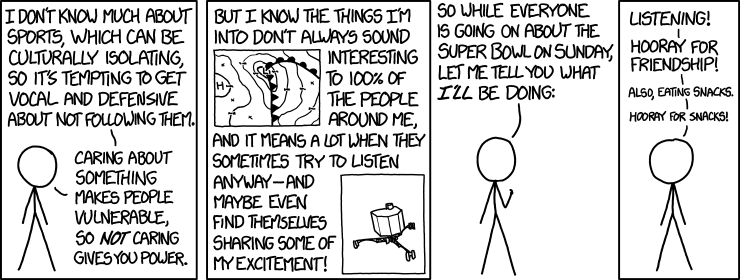
I don’t know much about football, but if I know one thing it’s that tI don’t know much about football, but if I know one thing it’s that the Green Bay Packers are objectively the best NFL franchise – and perhaps the best American sports franchise, period.

And this has nothing to do with their players (I couldn’t name any!), their coaching (ditto!), their track record (I’m utterly ignorant), or the skill with which they play (I’ve never seen them play, and even if I did I couldn’t tell skilled play from unskilled play).

No, the Packers are objectively the best NFL franchise because of their ownership structure.

You see, unlike every other NFL team, the Packers aren’t owned by some billionaire – they’re owned by their fans and the city of Green Bay. That means that when the city invests millions in a new stadium, the city isn’t borrowing money to enrich a billionaire, but rather its investing in an asset it owns. An asset that the people of Green Bay own. It means that the Packers can’t move to another town or threaten to move unless the city bribes them into staying. And it means that when the people of Green Bay, more than the people of any other American city, root for their hometown town team, they root for their hometown team.

To illustrate all the problems with the non-civic ownership, I’ll talk a lot about the Raiders. I’m not picking on them – they’re responding to the same incentives that every privately-owned NFL team has, and doing the same stuff all the other teams do. Only the Packers couldn’t do what they’ve done.

The Stadium Scam


Professional Athletics, especially the NFL, is incredibly profitable – and it nevertheless receives a variety of government subsidies, both explicit and implicit. The most visible of these subsidies is the public money spent on stadiums.

These subsidies are not trivial. New stadiums cost hundreds of millions – and cities have repeatedly picked up part of that cost. For instance, the Oakland Raiders move to Las Vegas was accompanied by the an agreement with Clark County and Vegas to build a new $1.8 billion stadium, (which will almost certainly end up costing more after the inevitable cost overruns). The public (in the form of Clark County and Las Vegas) is paying 750 million dollars (40% of the sticker cost) through a special hotel tax. And in exchange for this what do the people of Vegas and Clark County get? Some share of the rents, some revenue sharing from the stadium? No. They get nothing. They have taken on a 750-million-dollar liability in order to give the Raiders and the NFL a 750-million-dollar asset. This represents a transfer from the people of Clark county to the millionaires and billionaires who own the team. I can’t even call this crony capitalism – its simply looting. Raiders indeed.

For context: Clark County has a very serious homelessness problem. Given a 3.5% discount rate (about the coupon rate on Clark County bonds), an asset with a PV of 750 million dollars is equivalent to 26.25 a year indefinitely. That would be enough money to permanently house 20-30% of the approximately 6,400 homeless in Clark County.

Defenders of the deal will argue that this giveaway is justified because the stadium will increase economic activity and so bring in more tax. This is true, but it’s true of literally every other business and private-sector investment. If I start running a food truck, while I operate the truck I’m increasing economic activity and generating more tax revenue. That doesn’t mean that the government should pay for 40% of my truck in exchange for nothing! This is special pleading of the worst kind – the franchises and owners making this argument are essentially running a scam, hoping for a giveaway from the government.

Public ownership would make all the difference here. If Las Vegas / Clark County had bought the Raiders, then paid to build a stadium, and then moved them to Vegas, they would be investing in asset they owned. They’d being taking on liabilities in order to acquire assets – a normal sort of financial decision. Not the bullshit giveaway on display in the Raiders deal.

The Problem of Relocation


There’s a lot of civic pride and loyalty tied up in sports teams – but this feeling is not mutual. The Oakland Raiders are not, really, the Oakland Raiders. They are the Raiders that happen to be in Oakland. In 1982 they moved from Oakland to Los Angeles. In 1995 they moved back to Oakland. In 2019 or 2020, they’ll move again, this time to Las Vegas. I wonder how long they’ll stay there? 
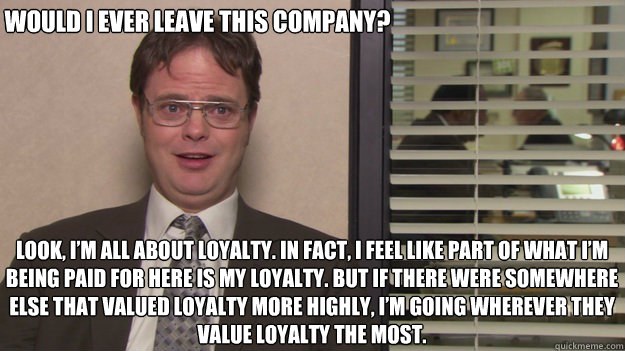
Image result for dwight schrute loyalty meme

This problem of relocation is tightly tied to the stadium scam. Privately-owned sports franchises can and do threaten to move unless their local governments shell out for shiny new facilities. These threats have repeatedly been carried out, and with franchises burning their bridges with local fans in pursuit of greater profits.

For example, consider the Baltimore Colts 1984relocation to Indianapolis The Colts left after a decade of feuding with state and local government over a new stadium. Their owner wanted free stuff from the government, didn’t get it, and so he ran off to Indianapolis.

In 1969 the city of Baltimore announced they would seek higher rental fees for the old Memorial Stadium. The Colts owner at the time, , had been threatening to move for some time and complained that the old stadium was inadequate and wanted the city of Baltimore to build a new stadium. In 1972 the city unveiled its proposal to build a new stadium (the “Baltodome”) which would serve both the Colts and the Orioles.. They estimated this would cost the city $78 million – about $470 million in 2018 dollars. Interestingly, earlier that year, the ownership of the Colts changed hands in a deal that valued them at $16 million (1972) dollars – meaning that the city could have bought them out and turned this stadium giveaway into an actual investment.

The Maryland legislature and the Baltimore comptroller were not on board with straight giveaways. Despite Maryland spending significant public money on stadium improvements, Irsay wanted more public investment (i.e. free capital improvements) in the stadium, so he began to shop around various cities, looking for someone who would bribe him into moving.

Things came to ahead in 1984. Baltimore didn’t have the money to give away a stadium to the Colts, but there was legislation in motion that would give the city the right to seize the team using eminent domain. So Isray quickly packed up and snuck off to Indianapolis under cover of darkness. Indianapolis had bribed Isray with the promise of a $12.5 million loan, a $4 million training complex, and a new $77.5 million training complex – worth $30 million, $10 million, and $188 million in 2018 respectively.

All this bullshit rigmarole wouldn’t have happened – couldn’t have happened – if Baltimore had owned the Colts. Maryland or Baltimore investing in new stadium for the team wouldn’t have been a fiscally indefensible giveaway to wealthy owners.

Civic Ownership or Corporate Ownership?


Cities are financially (through the stadium scam and other mechanisms) and emotionally invested in their sports franchises. I think that this is a, on balance, good thing, since it fosters civic pride and a shared identity, brings in money for cities, and, of course, sports are a recreational activity that people enjoy watching and participating in.

The problem with private ownership of sports franchises is that is that cities are financially and emotionally invested in assets they don’t control. Private ownership is corporate ownership. It means that the team will always be acting to maximize its profits – even if that means betraying the love and loyalty of its fans, or extorting financial concessions from fans or politicians (who might be worried about being blamed for the move) by threatening to move.
Telling them why the Packers Are Objectively the Best NFL Franchise
Do we think the owners of a business will put civic pride before profits?

Public or civic ownership, by contrast, solves this problem – the people of the city have control over an institution that they are all emotionally invested in. The mentality, loyalties, and identities around a sports franchises aren’t like the mentalities and identities and loyalties around usual private businesses. People think, talk, and feel as if these teams are cultural or civic institutions – because they are.

That’s how sports franchises should be run as as non-profits or under public ownership. Like the Packers.

Friday, June 29, 2018

Raise the Damn Minimum Wage


This might not be topical, but I think it’s important.

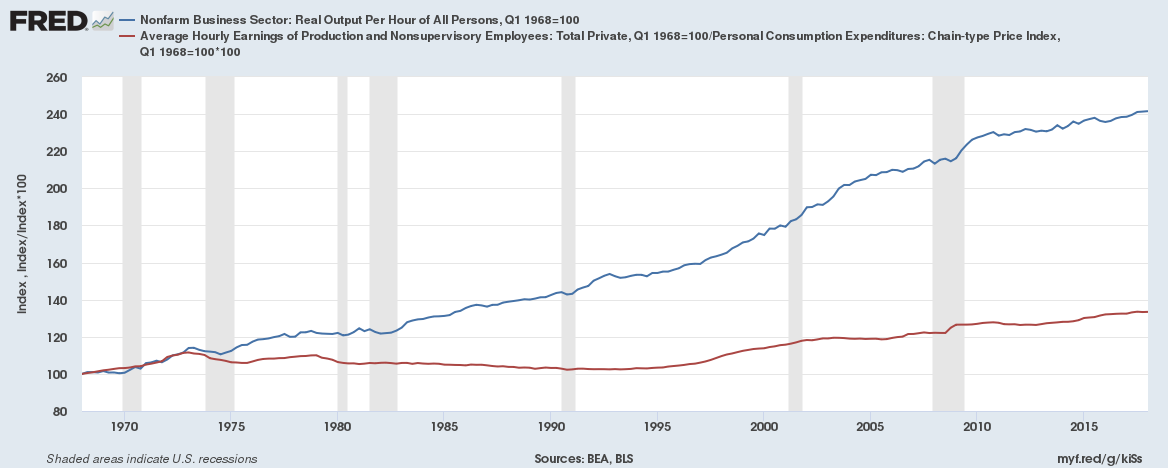
The real value of the US federal minimum wage peaked in 1968 at $8.60 in 2018 dollars (using a chained CPI - using a traditional CPI measure its closer to $11.50). If you were a naïve optimist, this would be surprising, since the United States is much richer today than it was in 1968, with GDP per person, productivity, and average wages all having grown significantly since then.

In 1968 the US had a (real) GDP per person of $23,000; that’s comparable to modern day Uruguay, Romania, Croatia, and Panama. Today our GPD per person is $53,000. That means that our society has more than twice the amount of resources per person we did in 50 years ago – though it sure as hell doesn’t feel like it.

Over the past 50 years, average wages in the US have increased significantly, while the federal minimum has increased, much more slowly.

In 1968, the minimum wage was about half the average hourly wage. In 2018 the minimum is less than a third. Note that this data excludes supervisory workers, so underestimates the growing divergence.

Productivity has also increased since 1968, with output per hour being 2.4 times what is was in 1968. Meanwhile, average hourly earnings are only 1.4 times what they were 50 years ago.
So what’s my point here? That raising the damn minimum wage is hardly the end of the fucking world, and people shouldn’t fucking panic about it.

Assuming perfectly competitive markets (stop laughing!), somebody who was paid $8.60 an hour in 1968 produced at least $8.60 of value an hour in 1968. I’ll be conservative and say productivity growth has been slower for minimum wage work than work on average, so their productivity has only increased by half as much – a mere 70%. Then an hour that created $8.60 of value 50 years ago should create $14.72 today.

Or we could take another track, and ask what the minimum would be if we tried to keep it at half the average. Since hourly average wages in 2018 are 22.60, the minimum wage would be $11.30.

Sunday, May 6, 2018

The Coming Automation Crisis


The coming automation crisis is not a technological crisis. Rather, it is a crisis of governance in the most basic sense. A fairly recent report from the Mckinsey Global Institute makes this obvious - though they studiously avoid drawing attention to this alarming conclusion.

Overall, MGI anticipates tens of millions of workers will be displaced by automation over the next 10-15 years, depending on the speed of automation. At the high end of their estimates, 73 million US workers (a little less than half of workforce!) would be displaced. Most of those displaced would have to switch occupations entirely. Their middle-of-the-road projection is still dramatic: only quarter of the workforce displaced, and with half of those switching occupation entirely.

The MGI report has plenty of suggestions for policy responses, but the US has essentially no public or private sector apparatus up to the challenge of smoothing this transition. The American government spends the least of any OECD country on labor markets. That money is used for job training and placement, for hiring subsidies and hiring in the public sector, and for unemployment benefits. Of the little money that is spent, only a tenth of that goes to job training – less than half of what Canada spends, and less than a sixth of what Germany spends, and a tenth of the amount France spends. The only tools that that remain are monetary policy and educational policy. 

Using monetary policy to maintain full employment is problematic for practical reasons and political reasons. The political problem is that central bankers tend to be more concerned with inflation than unemployment - witness the recent preemptive interest rate hikes by the US Fed. God forbid we should wait for robust wage growth before panicking about an inflationary spiral!

Even if by some minor miracle the Fed changed course and pursued a policy of full employment at all costs, the for-profit sector in the United States is not up to dealing with this crisis. MGI highlights a few firms who invest in employee development, but these anecdotes are misleading. Overall the share of workers receiving on-the-job or employer-sponsored training has declined sharply since 1996, and stagnated since 2004. You will note that this period includes part of the 1990s boom, and 2001-2007 boom. This is entirely rational behavior on the part of firms, since a worker who receives valuable training could find work elsewhere. And since firms show no loyalty to their employees, it would be sheer madness to expect workers to show loyalty to their employers,

This leaves only educational institutions and workers themselves. And educational institutions are not ready for this either. For people entering the labor force, the future looks bleak. Only about 36% of Americans age 25-29 have 4-year college degrees or more. For the majority American's associate degrees, high-school degrees, and the nebulous term "some college" are the highest level of educational attainment. For such people, quality high-school vocational programs are invaluable. But MGI’s best guess, since US data are hard to come by, is that less than 6% of Americans in secondary schools are enrolled in a vocational program, which would give those with only a high-school degree a fair chance That’s a smaller share enrolled than Brazil(!), and a tenth(!) of the Swiss level of enrollment. As far as post-secondary education goes, the federal state governments have systematically pulled back on support for public higher education for decades, exacerbating spiraling tuition costs and miring a generation of graduates in debt. What about community colleges, where displaced middle- and low-skill workers will most likely go for retraining? Data here are hard to come by, for the same reasons that data on high schools are hard to come by, but the ability of community colleges to handle the crisis does not look good. Tuition is not trivial, though it varies wildly across states - about $5,000 for in-state public schools. Student debt, graduation rates, and transfers to 4-year schools for community college graduates also looks terrible. About 10 million people are enrolled in community colleges in the US in any given year, with about 2.5 million full-time students. Remember we're talking tens of millions of workers displaced by automation over the period, with half that number needing to switch occupations entirely, requiring extensive retraining. I doubt our current educational system even has the capacity to cope with so many students, let alone provide a good education to all of them.

The MGI report helpfully makes two forecasts; a trend-line forecast where things continue as they are going and a step-up forecast where the government takes active measures to reduce the impact of automation on employment. Only the step-up forecast doesn't result in net job losses.

Read all that and tell me you aren't worried.

This is what I mean when I say the automation crisis is a crisis of governance. No problem described above cannot be addressed, even solved, by straightforward policy responses. Not  government that cannot act, not government that does not know how to act, but government that for structural and ideological reasons - political reasons! - will not act. This is the American Crisis today.


Wednesday, April 11, 2018

The Intellectual Death of Conservatism


I was going to write an ambitious, highly speculative piece tying together brain drain, anti-intellectualism, and disinvestment from education in the context of rural America. All that assumed that rural people are more anti-intellectual. But this paper from Jay A. DeSart of Utah Valley University blows that assumption out of the water.

If I’m reading his table right, he finds that rural people not significantly more likely to be anti-intellectual per-se, only that they’re more focused on practical education. But since rural America is older, less-educated, more religious, and more conservative, it looks like that at first glance. But some regression analysis to control for various factors causes that to drop away. Surprisingly (or perhaps not) after controls for, e.g. education income too is unassociated with anti-intellectualism.

So now I’m dipping into the literature to see what there is to see. DeSart’s paper, very helpfully, reports the strength of his findings and finds only 4 clusters of factors that are relevant with high confidence: Education, religiosity (church attendance, biblical literalism, etc.), political beliefs (ideology, sense of power over one’s life, trust in institutions, etc.) and gender.

So this is a cross-sectional snapshot. What about over time?

Enter Gordon Gauchat of University of North Carolina, Chapel Hill. He has a 2012 paper examining trends in politicization of anti-intellectualism and distrust of experts over time. SPOILER ALERT: American conservatives have been gradually getting more anti-intellectual and less trusting of experts since the 1990s. Liberals have trended in the opposite way. Quoting from the abstract:

Results show that group differences in trust in science are largely stable over the period, except for respondents identifying as conservative.


A more recent and in-depth study by Matthew Motta of University of Minnesota-Twin Cities finds the same thing in 2016 and shows further that support for Trump was associated with anti-intellectualism above and beyond the support for Trump from conservatives in general. That is, more anti-intellectual Republicans were more likely to support Trump.

So where does that leave the project that motivated this exploration? Sunk and gone. There are two real questions. First: why has conservative anti-intellectualism has grown and hardened? And second, what does this mean going forward. Here I will resume wild mass guessing – since after all I write this for my own amusement.

You may remember this poll that found that a majority of Republicans, for the first time ever, said they thought higher education was bad for the country.

Here’s one hypothesis: pure tribalism. Education tends to make people less conservative, and less anti-intellectual. If you want to keep people in the “tribe” of conservatism, you want to keep them away from higher education. This is, on an individual level, fairly rational. Of course you want to avoid the strife, the arguments, the emotional distance and social fracturing that will result from little Connor going off to college and forming a worldview that differs from your own. 

But this is somewhat hard to do, since it’s a well-established result that higher education generally leads to higher earnings and better life outcomes.

So, what you have to do is say to Connor “college is bad.” Not bad for Connor – because it plainly isn’t – but bad for society, bad in general.

You can see the shape of the intergenerational dynamics of this: the most intellectually inclined “educate out”  on the margin, becoming less anti-intellectual and less conservative. Leaving the rest more conservative and anti-intellectual.

But how did anti-intellectualism become so intertwined with American right? It could be religion, if religiously motivated anti-intellectuals have sorted into the GOP since the 1990s.
But my guess is that it is something more fundamental.

The death of expertise in the GOP and the anti-intellectualism of the conservative movement are intertwined. Why do you need experts? Because you care about what’s true and understand that the world is complicated and difficult to understand. But what if what is true is (politically) inconvenient? You could change your beliefs. Or you could change your beliefs about beliefs, and cease to care about the truth at all. But if the truth doesn’t matter, if facts don’t matter, if ideas are no longer tested by experience – why have experts? Why seek to know, why welcome knowledge at all?

And if your party doesn’t care about the truth, about knowledge, and intellectuals, almost definitionally, do, then of course you aren’t going to have much support among them, and every new cohort is going to look at the existing cohort and think – “why bother, they don’t care about my work”.

The GOP’s position on a host of issues follows this pattern – with climate change being the most clear-cut and obvious example. The entire trajectory of the policy minds around that man in the White House follows this pattern and I think it’s important to point out that this is not a break with the norms of the American right, but rather a continuation of decades-long trends.

So now for the second question: What does this mean going forward?

I don’t know, but I doubt its good. One possibility is that the conservative movement suffers an intellectual “death spiral” with each round of intellectuals exiting (or not entering) causing more hostility or indifference to intellectual thought, leading to more exits, etc.

That leaves a political movement that’s nothing but a seething ball of white rage with absolutely no regard for the facts and even the minimal restraints of reality. That seems… bad.

Another possibility is that intellectual collapse proceeds political collapse, and from the rubble a new, saner, coalition can be built. That would be a good outcome, but I imagine the process would be chaotic and uncertain.

One thing I do not see happening is this trend reversing anytime soon. For now, this is American politics.

Saturday, March 10, 2018

On Being Unafraid.


Fear is not a useless emotion. Fear can keep you alive. It is often rational to be afraid. But fear is not itself rational. It is a wild, unreasoning emotion, the enemy of reason. Fear wants to move your feet for you, wants to speak for you and act for you and deprive you of your will – in the moment fear can keep you alive, move you faster and further than wolves behind you, give you the strength to go on, to overcome, to survive the crisis. This a healthy fear.

But Americans (especially older Americans) seem to me a fearful people, though whether they are more or less fearful than any other I cannot say, and their fears seem much more the unhealthy sort. They are more afraid of terrorists than dogs, of strangers than intimates, of crime than of crossing the street. I my head understands this, that to most it is somehow much worse for a bad thing to be done to you than for a bad thing to simply happen, that malice terrifies while incompetence frustrates. My heart does not understand this though. When I think of the things that could ruin my life, that could harm me, that menagerie of misfortune is populated principally with the spawn of incompetence. Those creatures of malevolence are a sideshow compared to them.

And then there are the natural disasters that people fear, but to fear them is useless. After taking the precautions you think best, terror will not help you survive a tornado. If you let it though. it will gnaw at your guts before the storm and torment you – useless suffering which offends my sensibilities. The fear of incompetence may drive us to scrutinize the work of others, the fear of indifference may cause us to speak for ourselves, the fear of malice may push us to look to our protection, and live cautiously.

But the fear of the storm? We build our shelters, and weather what we must. All further concern is masochistic.

Now I am not a fearful sort, as a rule. I see the harm fear does, the madness and misrule it inspires, and whenever and know that courage is the first virtue – without it all the rest fall silent. So, I strive to overcome fear to master it, lest it master me.

But all of this is preamble, aside from my main point. Consider the phenomena of a gamma-ray burst. When a star dies and goes nova, a burst of high energy gamma rays shoots out from the star as a ray traveling at the speed of light. Such events are uncommon, even on an astronomical scale, and if it were to happen in our galaxy there is only a minute chance it would hit us.

But if did hit us, we would not see it coming, since the radiation travels at the speed of light, and it would be as if we microwaved the whole earth on high for half an hour. The atmosphere would burn off, the seas would boil, and on the whole surface of the earth and in the deepest depths there would not remain a single living thing or trace of our civilization. The entirety of the human race, all our works, the whole humanity’s history and our homeworld could vanish in instant, without and forewarning or chance of survival. What do you when there is no shelter from the storm? Take a moment to think on this.

When I first learned this , I was afraid. But I overcame that fear – it was the most useless of fears. I got on with my life, in doing so I learned a subtle truth: That safety is an illusion - there are only different levels of risk. The risk of a gamma-ray burst is small, and not my efforts or the efforts of the whole human race could reduce that risk one way or the other. It is simply there. Something to be endured.

And this comes back to the madness and misrule of fear – fear drives us to seek safety, but there is no safety. The politics of fear is that of promising safety (impossible!) or more accurately of promising to make people feel safe. And I don’t know what to do about that. I would like for voters to wise up, to overcome their fear, to accept that to live is to be at risk, to understand that safety is an illusion, and that the reduction of risk is never done without cost. But it is easier and more profitable to terrify than to reassure, so I expect nothing will change in this regard. We will frighten each other, and cook in our own fear until its softened our brains to the point where we’ll support anyone who promises to make us feel safe.

Monday, March 5, 2018

First Impressions


My earliest political memory is of the shitshow that was the aftermath of the 2000 election. I heard the words “Florida” and “Supreme Court” together so many times that 8-year-old me assumed that that was were the Supreme Court was located.  Growing older and looking back on the mess, on the miscarriage of democracy that was Bush’s victory in the Elector College, on the Supreme Court shutting down recounts of a razor thin margin on strictly partisan lines. I’ll say it plainly: I think the 2000 election was stolen by the Republicans. If democracy means anything it means that the people’s most preferred candidate wins. Not the candidate with 5 votes on the Supreme Court.That they were willing to steal it, and that having stole it defended their actions, and that American people didn’t hate them for this – all cements in my mind the conviction that even in America – perhaps especially in America – democracy isn't some fixed feature of our civilization, but a value system (an ideology!) that needs to be defended.

My second political memory is of 9/11. A teacher came in and said “there’s been an attack”, and everyone stopped and waited and watched. You could the tension with a knife, all the adults, and because of the adults, all the children were poised to flight, flee, or freeze. And I remember thinking: “An attack where in Bloomington?” and later: “We are in Bloomington, Indiana. New York and DC are far away. Why is everyone afraid?”. I’ve kept thinking that to this day – that the terrain of the terrorist is our psyche, the objective is to provoke stupid anger or paralyzing fear, and that overcoming them is as simple (and difficult!) as having courage and carrying on. But Americans were afraid, and vengeful, and foolishly they lashed out - invading Afghanistan, (and then Iraq). Children who were in that 2nd grade class that day are now old enough to die in that graveyard of empire. I write this in 2018, and there is no prospect for withdrawal prior to 2019 – at which point someone born on 9/11 will be old enough to die in Afghanistan. All this – because vengeance drove us to war, and hubris keeps us fighting an unwinnable fight.

My third political memory is of a two-page spread in Newsweek. This was in the run up to the Iraq War, when Saddam let in UN inspectors to demonstrate that he didn’t have WMD’s, and the Bush Administration and the media weren’t willing to let a little thing like facts get in the way of war-fever. This was a two-page spread showing how Saddam could have hid is chemical weapons from UN inspectors using mobile labs and storage facilities. It was fascinating to a child. How intricate, how clever! But like many schematics that charm children, the notion falls apart at the slightest consideration of practicality. Why build mobile labs so far in advance when you didn’t anticipate inspectors? Wouldn’t transporting chemical weapons be very dangerous, and vulnerable to theft and attack? Why would and oil-rich dictator run his chemical weapons program out of facilities out of the equivalent of an RV meth lab?

Few at the time bothered with such questions. And those who did were derided and ignored. The Bush Administration lied – no not a lie, but rather fed us Frankfurtian bullshit with an utter disregard for the truth, and the media believed them, and people believed the media. And so, we piled up a trillion dollars in the desert along with tens of thousands of lives– and then set the whole heap on fire. How many among them apologized, or admitted their mistake – not just the politicians but the pundits and the rest of the chattering classes? How long has our endless war in the middle east gone on, without sign or hope of victory?

Especially among the right, those responsible, whether by negligence or malice, have lost little prestige, credibility, or readership and still linger in our national life. Time smooths rough edges and cools hot anger. But my first impressions of the Republican party, its policies and partisans, has given me an anger as cold and slick as ice.

Saturday, February 24, 2018

The Fundamental Problem of Practical Ethics

When I think of the arguments for my political opinions (I’ll not aggrandize them by calling them beliefs), they often run like this: people have moral weight, therefore its not good to harm them, or through inaction allow them to come to harm (apologies to Asimov). So now we’re committed to helping others, and so we debate the best way to do that, the best way to for it, and so on.
For example: we aren’t OK with people dying in the streets because they can’t afford healthcare. So we (as a society) will guarantee that doesn’t happen by some mechanism. But somebody has to pay for that mechanism. I think the best (or perhaps it would be better to say, the best politically feasible and sustainable) way to do that is through single-payer healthcare. But it is more important to me that the problem is solved than that problem is solved in the best possible way. So while we might disagree about the appropriate mechanism, about how pays and how, but we recognize that there is a problem caused by our moral commitments to other human beings, and we desire to solve that problem in some way.

But when I interrogate this argument I notice a stumbling block, which has, as I have grown older, seemed less like the exotic cruelty of the sociopath and more the ordinary cruelty that Americans swim in. If I say “Its not right to just let people die in the streets of some ordinary illness, just because they haven’t got any money”, how many will say “Why not? I do not know these people, they are not me, or my kin, why should I care?”. That response chills me and leaves me dumbfounded. And perhaps after some flailing argumentation, I will retreat into a long silence.

Because I do not have a good answer to that question. “Why should I care about other people?”. I cannot explain it. Those with whom I have political disagreements who do not think, cannot think to ask that question, who do not see empathy and compassion as self-evident, I cannot disagree with them about ways and means of attaining goals. I disagree with them about beginnings and ends. To my mind, a person who simply does not care about other people, who cannot even muster up some feeble excuse for their cruel indifference, such a person is simply a bad person.

And all of this troubles me greatly, because it is hard to square the common (in certain influential circles) refrain for bipartisanship and compromise, that there are two (morally defensible) sides to every argument, the popular belief among the apolitical that the truth always lies between two extremes, and that political virtue involves giving all sides weight, with the belief, even the knowledge that some of my political opponents are simply bad people. This is difficult for the apolitical and those who participate in politics while disdaining it. Their minds rebel against the notion. This denial of the plain facts is as much a barrier to reform and progress, to the concrete improvement of the world, than the indifference of the cold-hearted to the suffering of others.

Edmund Burke, that famous conservative, one said “All that is required for evil to triumph, is for good men to do nothing”. I do not think the apolitical are bad people. I am sure that in their private lives they are by large as kind and decent as other folk, perhaps more so. But I think they are very inclined to do nothing.

Tuesday, February 14, 2017

Nationalism and Patriotism, Republicans and Democrats

What is the difference between nationalism and patriotism? It is the difference between the love of nation and the love of country. In our modern age of nation-states that fine distinction is often lost, or deemed irrelevant, but in the context of American politics I think it explains much.

The etymology of "patriotism" and "patriot" is the Latin word patria, which might be best translated as "homeland" or "fatherland". Patriotism, therefore, is the love of a country, and often accompanied by a loyalty to the state that governs that country. In the American context, where our national origin story is one of the frontier, a new land conquered and settled to found an intentional community on some set of shared values. The "American people", to the patriot, are in classical Greek terms a demos, a political community of all the inhabitants of the same fatherland. 

But the nationalist does not love a country, per se, rather, the nationalist loves a nation, an ethnic group, and so only a nation-state, a state created by, or at least for, that group can command the loyalty of the nationalist. Nationalism isn't necessarily exclusive, and the nationalist doesn't inevitably desire a homogeneous ethno-state or support ethnic cleansing to obtain it. But the train of nationalist thought can lead to that conclusion without being derailed by contradiction. Thus to an American nationalist the "American people" are an ethnos, a single ethnic group.

Both nationalists and patriots "love their country". The patriot loves his country because it is his fatherland, and so his love is the unconditional filial devotion of children to their parents. Thus where the patria embodies his (and its) ideals he is filled with pride, and where it falls short of those ideals he aspires to lift it up and repair its mistakes.

But the nationalist, the nationalist loves his country because it is their country, because it belongs to his nation (which is of course a great nation), and thus is a great country. And so long as the country remains the possession of his nation he loves it, and so long as the state is commanded by his nation he obeys it. But if his country should change, if his nation should become less dominant within it, if nation should cease to command the state, he will cease to love his country or to obey its state. For the nationalists "love of country" is utterly conditional and transnational, a passing affection that exists only so as long as country and state serve his nation.

What does this mean for American politics? I advance this hypothesis: that today Democrats are patriots and Republicans are nationalists. Thus the Democrats seek to define and advance the values of their patria and serve the interests of the demos. To understand them we need only seek to understand their values. But Republicans are nationalists, (or at least the Trumpists) and the nation they love is white Anglophone Americans. Their political cause is protect and advance the power and interests of that nation, regardless of all other people.

The hazards that ideology, if left unchecked, poses to the American republic should  be obvious.