Showing posts with label The American Crisis. Show all posts

Monday, July 2, 2018

Sunshine Patriotism


I am ashamed to be an American.

How is that I can be ashamed to be an American?

“These are the times that try men's souls: The summer soldier and the sunshine patriot will, in this crisis, shrink from the service of their country; but he that stands it now, deserves the love and thanks of man and woman. Tyranny, like Hell, is not easily conquered; yet we have this consolation with us, that the harder the conflict, the more glorious the triumph. What we obtain too cheap, we esteem too lightly: it is dearness only that gives every thing its value. Heaven knows how to put a proper price upon its goods; and it would be strange indeed if so celestial an article as freedom should not be highly rated.”
Thomas Paine The American Crisis (1776)

I can be ashamed to be an American, because I can also proud to be an American. That pride and shame come mixed together is right and correct. How could I lay some claim to a share of America’s glories and triumphs, our virtues and victories, if I do not also claim a share too of our defeats and failures, our vices and shames? I personally am not responsible for any of these things. Only a person of low and contemptible character would behave in such a way, a sunshine patriot who abandons any cause or loyalty the moment it becomes difficult, who spurns any love that might become complicated. It is easier, I suppose, for such a person to pretend there is no tension between the good and bad of American history, that ours is one of uncomplicated moral rightness and that the American state or the American people have never been in any way villainous, and to subscribe to a simple-minded version of events in which “We” are the “Good Guys” and “They” are the “Bad Guys”.

But I am not such a coward, and cannot turn away from uncomfortable truths. It is a fact apparent to all who care to know that American history is replete with the successes of American science, technology and industry, with triumphs of American arms, and a culture with as much reach and influence as any other in the history of humankind. We put a man on the moon! There is no place in this world far from American soldiery, no place where American music cannot be heard. (Whether this a good thing is another question entirely…). But history is a bottomless well of horrors, and our well might be shallower, but o! how horrible the horrors are. I’ll not trouble your stomachs by describing to them to you in any great detail, a simple list should suffice to remind you.

The violence and endless broken promises with which Americans have dealt to indigenous peoples, the brutal and savage institution of slavery, and the long train of racial injustices that spawned leading up to the present day, the oppression of women, the closing of our borders to people in need, the internment of Japanese-Americans, our involvement in foreign nations, first in Latin America and then throughout the world, which betrayed any humanitarian or democratic impulse to greed, hunger for power, and a pursuit of bloody-handed empire. I cannot ignore these things for the same reason I cannot ignore the sky.

In truth, I do not feel proud to be an American. I cannot make a ledger of virtue and vice, sum up the good and the bad, and hold that America is a thing to proud of on the net. I am not the sort that thinks one can erase an act of evil with an act of kindness – undo perhaps, but erase; never – and what has been done, the suffering that has been caused is to much for me, my heart is to weighed down by shame to feel much pride.

But there is hope. I think that there is some strain of virtue in America, a history too of good intentions and high ideals, and I hope that these things will in the end win out. I am not proud of America today, but it is my hope that I will live to see the America made by the victory of those ideals. An America I can be proud of.

Friday, June 29, 2018

Raise the Damn Minimum Wage


This might not be topical, but I think it’s important.

The real value of the US federal minimum wage peaked in 1968 at $8.60 in 2018 dollars (using a chained CPI - using a traditional CPI measure its closer to $11.50). If you were a naïve optimist, this would be surprising, since the United States is much richer today than it was in 1968, with GDP per person, productivity, and average wages all having grown significantly since then.

In 1968 the US had a (real) GDP per person of $23,000; that’s comparable to modern day Uruguay, Romania, Croatia, and Panama. Today our GPD per person is $53,000. That means that our society has more than twice the amount of resources per person we did in 50 years ago – though it sure as hell doesn’t feel like it.

Over the past 50 years, average wages in the US have increased significantly, while the federal minimum has increased, much more slowly.

In 1968, the minimum wage was about half the average hourly wage. In 2018 the minimum is less than a third. Note that this data excludes supervisory workers, so underestimates the growing divergence.

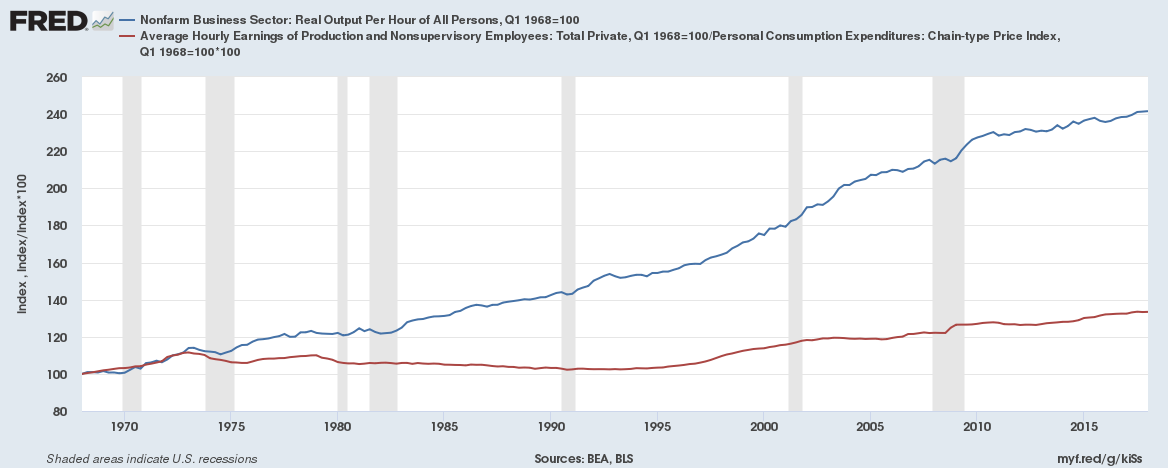
Productivity has also increased since 1968, with output per hour being 2.4 times what is was in 1968. Meanwhile, average hourly earnings are only 1.4 times what they were 50 years ago.
So what’s my point here? That raising the damn minimum wage is hardly the end of the fucking world, and people shouldn’t fucking panic about it.

Assuming perfectly competitive markets (stop laughing!), somebody who was paid $8.60 an hour in 1968 produced at least $8.60 of value an hour in 1968. I’ll be conservative and say productivity growth has been slower for minimum wage work than work on average, so their productivity has only increased by half as much – a mere 70%. Then an hour that created $8.60 of value 50 years ago should create $14.72 today.

Or we could take another track, and ask what the minimum would be if we tried to keep it at half the average. Since hourly average wages in 2018 are 22.60, the minimum wage would be $11.30.

Sunday, May 6, 2018

The Coming Automation Crisis


The coming automation crisis is not a technological crisis. Rather, it is a crisis of governance in the most basic sense. A fairly recent report from the Mckinsey Global Institute makes this obvious - though they studiously avoid drawing attention to this alarming conclusion.

Overall, MGI anticipates tens of millions of workers will be displaced by automation over the next 10-15 years, depending on the speed of automation. At the high end of their estimates, 73 million US workers (a little less than half of workforce!) would be displaced. Most of those displaced would have to switch occupations entirely. Their middle-of-the-road projection is still dramatic: only quarter of the workforce displaced, and with half of those switching occupation entirely.

The MGI report has plenty of suggestions for policy responses, but the US has essentially no public or private sector apparatus up to the challenge of smoothing this transition. The American government spends the least of any OECD country on labor markets. That money is used for job training and placement, for hiring subsidies and hiring in the public sector, and for unemployment benefits. Of the little money that is spent, only a tenth of that goes to job training – less than half of what Canada spends, and less than a sixth of what Germany spends, and a tenth of the amount France spends. The only tools that that remain are monetary policy and educational policy. 

Using monetary policy to maintain full employment is problematic for practical reasons and political reasons. The political problem is that central bankers tend to be more concerned with inflation than unemployment - witness the recent preemptive interest rate hikes by the US Fed. God forbid we should wait for robust wage growth before panicking about an inflationary spiral!

Even if by some minor miracle the Fed changed course and pursued a policy of full employment at all costs, the for-profit sector in the United States is not up to dealing with this crisis. MGI highlights a few firms who invest in employee development, but these anecdotes are misleading. Overall the share of workers receiving on-the-job or employer-sponsored training has declined sharply since 1996, and stagnated since 2004. You will note that this period includes part of the 1990s boom, and 2001-2007 boom. This is entirely rational behavior on the part of firms, since a worker who receives valuable training could find work elsewhere. And since firms show no loyalty to their employees, it would be sheer madness to expect workers to show loyalty to their employers,

This leaves only educational institutions and workers themselves. And educational institutions are not ready for this either. For people entering the labor force, the future looks bleak. Only about 36% of Americans age 25-29 have 4-year college degrees or more. For the majority American's associate degrees, high-school degrees, and the nebulous term "some college" are the highest level of educational attainment. For such people, quality high-school vocational programs are invaluable. But MGI’s best guess, since US data are hard to come by, is that less than 6% of Americans in secondary schools are enrolled in a vocational program, which would give those with only a high-school degree a fair chance That’s a smaller share enrolled than Brazil(!), and a tenth(!) of the Swiss level of enrollment. As far as post-secondary education goes, the federal state governments have systematically pulled back on support for public higher education for decades, exacerbating spiraling tuition costs and miring a generation of graduates in debt. What about community colleges, where displaced middle- and low-skill workers will most likely go for retraining? Data here are hard to come by, for the same reasons that data on high schools are hard to come by, but the ability of community colleges to handle the crisis does not look good. Tuition is not trivial, though it varies wildly across states - about $5,000 for in-state public schools. Student debt, graduation rates, and transfers to 4-year schools for community college graduates also looks terrible. About 10 million people are enrolled in community colleges in the US in any given year, with about 2.5 million full-time students. Remember we're talking tens of millions of workers displaced by automation over the period, with half that number needing to switch occupations entirely, requiring extensive retraining. I doubt our current educational system even has the capacity to cope with so many students, let alone provide a good education to all of them.

The MGI report helpfully makes two forecasts; a trend-line forecast where things continue as they are going and a step-up forecast where the government takes active measures to reduce the impact of automation on employment. Only the step-up forecast doesn't result in net job losses.

Read all that and tell me you aren't worried.

This is what I mean when I say the automation crisis is a crisis of governance. No problem described above cannot be addressed, even solved, by straightforward policy responses. Not  government that cannot act, not government that does not know how to act, but government that for structural and ideological reasons - political reasons! - will not act. This is the American Crisis today.