Showing posts with label justice. Show all posts

Tuesday, July 30, 2019

What Is Even the Point of This?

I haven't been able to get this case out of my head lately, so I'm putting my thoughts into writing in the hopes that that solves my problem.

The facts are these - guy accidentally leaves two of his kids in a hot car, goes to work, and eight hours later they're dead. A fucking tragedy. I feel for the guy, for his wife and for his three surviving kids - their family's fucking torn apart and this guys gonna have to live with the guilt of that for the rest of his life.

Then the DA's office for the Bronx gets involved and decides their gonna make it all better the only way they can - by charging him with manslaughter and negligent homicide. What is even the point of this? What good will this serve? How will this advance justice?

The point(s) of the criminal justice system are (per Wikipedia):

  1. Deterrence  - "we don't want people to do this, we need to make an example of him"
  2. Retribution / Moral Support for Victim - "guys got to pay for what he did"
  3. Rehabilitation / Reform - "he learned his lesson and won't do it again"
The guy fucked up and killed two of his kids. What could the criminal justice system do on any of these fronts that's more potent than what's already happened?

Who is reading this story and going "Well, I was planning on being a negligent parent and a risking the lives of my kids, but now that I see I could face criminal penalties for killing my babies, I'll shape up and fly right?"

What provides more moral support for the family of the victim by tearing that family apart even more than its already been torn apart.

And reform, do these guys really think that he negligently killed some of his kids but they if don't send him to prison he might negligently kill the rest of them?

The best, most generous possible fucking argument for the decision to go after this is that its just an awareness raising measure; but all of this - all of this! - the press coverage, the trial, and any potential punishment, is going to cost hundreds of thousands of dollars. You're seriously telling me that this is better way to raise awareness than dropping that cash on ad campaign? That you're willing to throw a guy in prison for years as fucking publicity stunt?

Thursday, August 9, 2018

Solve the Fucking Murders

In 2017, Chicago experienced 650 murders. CPD cleared 17% clearance of those murders.

In 2017 NYC experienced 269 murders. NYPD cleared 77% of those murders.

CPD and NYPD have similar budgets per capita ($400-600 per city resident). They employ similar numbers of officers per resident (~4.4 and ~5.2 officers per thousand, respectively).

And in absolute terms CPD solved HALF as many murders as NYPD did.

A lot of this is resource disparities. I'm going to be sloppy and just divide overall department budgets by the murders. It's my blog - you can't stop me!

NYPD's budget is ~ 5.6 billion. That's $20 million per murder, and $27 million per solved murder.

CPD's budget is ~1.5 billion. That's ~$2.3 million per murder and $14 million per solved murder.

But here's the thing - the whole police department ins't dedicated to solving murders. Resources can be shifted around, things can be reprioritized (e.g. minimal investigation of non-violent crime.). CPD can do their jobs more effectively.

And frankly, budgets can be increased - and spending that brings down the homicide rate is almost certainly a good deal for the city because of how much money murders cost. That study estimated that the tangible costs alone of each murder at $1.2 million - so 650 homicides is HALF the entire budget of CPD. Add in intangible costs and Chicago homicides are costing society more than the entire city budget. Even if you think that those intangible estimates are too high, its still a huge number.

So what does this lead me to think?

1) Chicago should commit more resources to law enforcement - especially solving murders.

2) CPD needs to get their shit together, embrace reform and innovation, and commit do doing whatever it takes for them to solve the fucking murders.

Thursday, July 12, 2018

Something Topical

I don't usually write topical posts, but I just saw something that stuck in my craw. This latest executive order from the Trump administration is not good.

In a nutshell, it changes the procedures for the hiring and firing of administrative judges in a way that undermines their independence.

In the old system administrative law judges were hired from a list of "generally qualified judges" and had to go through the usual procedures of civil service hiring - competitive selection and examination, background checks, etc.

That changed.

Now agencies can simply appoint (and fire!) administrative law judges without going through any of those proceedures. The executive order justifies this change by citing a 6-3 US Supreme Court decision earlier this year that held that administrative law judges were "officers of the court" not federal employees.

All of that you could have gotten from reading the first link here. Now let me explain why this is bad. 

By volume of text, the bulk of the law in the US isn't statutory (i.e. Congress passed a law) but administrative (Congress delegated rule-making authority in some area to an executive agency, with a certain mandate). Think regulatory agencies like the EPA, the SEC, etc.

When people want to dispute fines, regulations, any matter relating to administrative law, that ends up before an administrative law judge, who is to quote Wikipedia: " a judge and trier of fact". These proceedings are bench trials (that mean no jury). 

So if the EPA alleges I poisoned Lake Michigan and fines me, and I dispute this, an administrative judge decides the punishment I'd receive if guilty, and whether or not I actually poisoned the Lake. Creating the potential for a shamelessly corrupt official to dismiss the EPA's case against me with alternative facts - or decide against me regardless of the facts.

Now administrative judges have always had this power. But before abusing this power was less of a concern - they were career civil servants, insulated from political pressures and subject to the normal constraints and scrutiny placed on civil servants - and protected from arbitrary firing like other civil servants.

Now the President or his appointees can appoint or fire them at will. Bribery is illegal, of course. But you could still sway the decisions by appointing crackpots who believe whatever B.S. passes his desk, as long its on the side of business ("Arsenic is an essential mineral", "kids need lead to grow up healthy", "humans aren't causing climate change").

TL;DR, the administration is undermining the independence of a judiciary, and creating a lot of opportunities for graft and misconduct. You don't have to be a cynic to think they'll take advantage of those opportunities.


Friday, June 29, 2018

Raise the Damn Minimum Wage


This might not be topical, but I think it’s important.

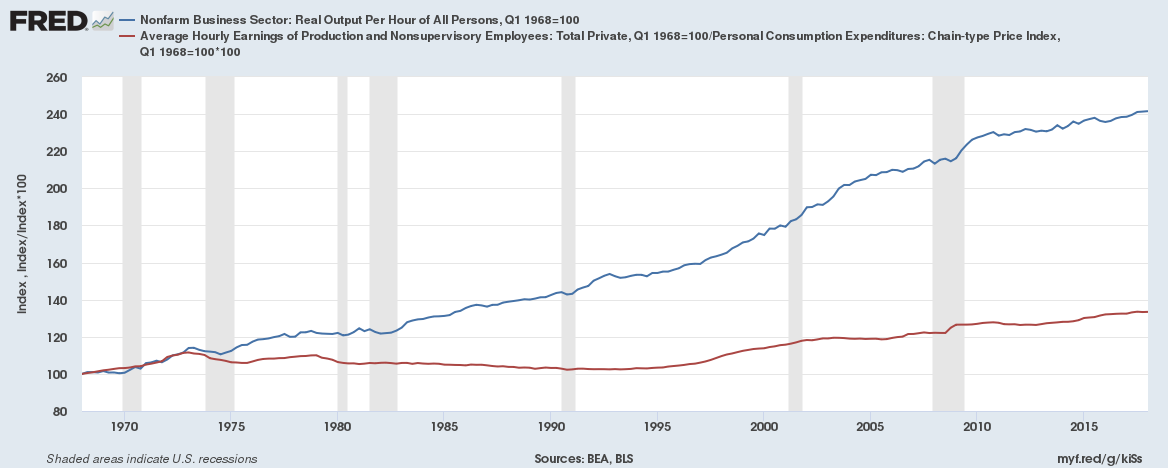
The real value of the US federal minimum wage peaked in 1968 at $8.60 in 2018 dollars (using a chained CPI - using a traditional CPI measure its closer to $11.50). If you were a naïve optimist, this would be surprising, since the United States is much richer today than it was in 1968, with GDP per person, productivity, and average wages all having grown significantly since then.

In 1968 the US had a (real) GDP per person of $23,000; that’s comparable to modern day Uruguay, Romania, Croatia, and Panama. Today our GPD per person is $53,000. That means that our society has more than twice the amount of resources per person we did in 50 years ago – though it sure as hell doesn’t feel like it.

Over the past 50 years, average wages in the US have increased significantly, while the federal minimum has increased, much more slowly.

In 1968, the minimum wage was about half the average hourly wage. In 2018 the minimum is less than a third. Note that this data excludes supervisory workers, so underestimates the growing divergence.

Productivity has also increased since 1968, with output per hour being 2.4 times what is was in 1968. Meanwhile, average hourly earnings are only 1.4 times what they were 50 years ago.
So what’s my point here? That raising the damn minimum wage is hardly the end of the fucking world, and people shouldn’t fucking panic about it.

Assuming perfectly competitive markets (stop laughing!), somebody who was paid $8.60 an hour in 1968 produced at least $8.60 of value an hour in 1968. I’ll be conservative and say productivity growth has been slower for minimum wage work than work on average, so their productivity has only increased by half as much – a mere 70%. Then an hour that created $8.60 of value 50 years ago should create $14.72 today.

Or we could take another track, and ask what the minimum would be if we tried to keep it at half the average. Since hourly average wages in 2018 are 22.60, the minimum wage would be $11.30.

Tuesday, March 20, 2018

"Are we the baddies?"

So Trump's pick for CIA director is a veteran torturer. Feminism in the 21st century - now women too can be clear-cut villains.

               In Star Wars, how is it established that the Rebels are the “good guys” and the Empire are the “bad guys”? That is, what shortcuts are taken over the length of feature film that allow the audience to identify the morality of each side of the conflict? Oh, certainly we are inclined by mere familiarity to sympathize with Luke, a humble farmboy from a backwater planet dreaming of the stars. But Imagine if you will that you were watching the film de novo, (difficult I know). Luke casually remarks that he is thinking about becoming a pilot for the Empire! If the villainy of the Empire isn’t immediately obvious to Luke, our sympathetic protagonist, how is obvious to us?

                First is the style of the empire, meant to evoke the Third Reich. “Stormtroopers” and cleanly cut grey uniforms – the assumption being that the audience would make the association with fascism, and with fascism to plain evil. Another trick for managing our sympathies are the face-concealing masks of the stormtroopers, meant to dehumanize the antagonists.

                But it is in the conduct of the Empire that its essentially villainous nature is laid bare. The audience is expected to immediately and unambiguously look at the actions of the Empire and go: “They are the bad guys, only bad guys would do things like that”.

                So, what does the Empire do? In the pursuit of vital intelligence, the Empire kills innocent civilians, tramples on civilian authority, and tortures suspects. With the aim of intimidating its enemies it a weapon of mass destruction and demonstrates it on a target of limited military value. It tramples on democratic rights and institutions in the name of peace and order.

                But save the last, the United States has done all these things. The secrecy of the security state, warrantless wiretapping and mass-surveillance, the absurdly broad war-making powers in the post-9/11 AUMF altogether seem to constitute, if not trampling, then at least walking, on civilian authority. The drone war – in Pakistan, Yemen, Afghanistan, Syria, and other places, may or may not keep America safe, but it certainly sheds a lot of innocent blood. And of course the United States used – perhaps is still using, for such things are kept secret – torture with the aim of obtaining vital intelligence. We developed nuclear weapons and used them on targets of limited military value (Nagasaki and Hiroshima were chosen precisely because for that reason they had been only lightly damaged in previous bombings). And after demonstrating our power, we used our to advance ourselves at the expense of others. And the American government has in the past, and continues in the present, to be much more talk than action on human rights – even the rights of its own citizens.
               
            Now, all of these things, it is argued, were done from necessity. Perhaps so. But I am somewhat concerned that the American people did not, do not, balk at these acts, that we do not turn our heads and go: “No that is not us, we’re the good guys, the good guys don’t do that”. It suggests that, at least for some, the reason why the Empire is the villain of Star Wars is not because the Empire is bad, but because the Empire opposes the protagonist. That because of the choices of the storyteller we do not sympathize with Luke because he is the “good guy”, but rather he is the “good guy” because we sympathize with him. That the same story could be told as a tragedy, with Empire doing everything it has to, yes, even unpleasant things, to protect itself, but despite its sacrifices is still overthrown. That you could easily make Vader the hero, and Luke the villain – and that people would believe it.

Saturday, March 10, 2018

On Being Unafraid.


Fear is not a useless emotion. Fear can keep you alive. It is often rational to be afraid. But fear is not itself rational. It is a wild, unreasoning emotion, the enemy of reason. Fear wants to move your feet for you, wants to speak for you and act for you and deprive you of your will – in the moment fear can keep you alive, move you faster and further than wolves behind you, give you the strength to go on, to overcome, to survive the crisis. This a healthy fear.

But Americans (especially older Americans) seem to me a fearful people, though whether they are more or less fearful than any other I cannot say, and their fears seem much more the unhealthy sort. They are more afraid of terrorists than dogs, of strangers than intimates, of crime than of crossing the street. I my head understands this, that to most it is somehow much worse for a bad thing to be done to you than for a bad thing to simply happen, that malice terrifies while incompetence frustrates. My heart does not understand this though. When I think of the things that could ruin my life, that could harm me, that menagerie of misfortune is populated principally with the spawn of incompetence. Those creatures of malevolence are a sideshow compared to them.

And then there are the natural disasters that people fear, but to fear them is useless. After taking the precautions you think best, terror will not help you survive a tornado. If you let it though. it will gnaw at your guts before the storm and torment you – useless suffering which offends my sensibilities. The fear of incompetence may drive us to scrutinize the work of others, the fear of indifference may cause us to speak for ourselves, the fear of malice may push us to look to our protection, and live cautiously.

But the fear of the storm? We build our shelters, and weather what we must. All further concern is masochistic.

Now I am not a fearful sort, as a rule. I see the harm fear does, the madness and misrule it inspires, and whenever and know that courage is the first virtue – without it all the rest fall silent. So, I strive to overcome fear to master it, lest it master me.

But all of this is preamble, aside from my main point. Consider the phenomena of a gamma-ray burst. When a star dies and goes nova, a burst of high energy gamma rays shoots out from the star as a ray traveling at the speed of light. Such events are uncommon, even on an astronomical scale, and if it were to happen in our galaxy there is only a minute chance it would hit us.

But if did hit us, we would not see it coming, since the radiation travels at the speed of light, and it would be as if we microwaved the whole earth on high for half an hour. The atmosphere would burn off, the seas would boil, and on the whole surface of the earth and in the deepest depths there would not remain a single living thing or trace of our civilization. The entirety of the human race, all our works, the whole humanity’s history and our homeworld could vanish in instant, without and forewarning or chance of survival. What do you when there is no shelter from the storm? Take a moment to think on this.

When I first learned this , I was afraid. But I overcame that fear – it was the most useless of fears. I got on with my life, in doing so I learned a subtle truth: That safety is an illusion - there are only different levels of risk. The risk of a gamma-ray burst is small, and not my efforts or the efforts of the whole human race could reduce that risk one way or the other. It is simply there. Something to be endured.

And this comes back to the madness and misrule of fear – fear drives us to seek safety, but there is no safety. The politics of fear is that of promising safety (impossible!) or more accurately of promising to make people feel safe. And I don’t know what to do about that. I would like for voters to wise up, to overcome their fear, to accept that to live is to be at risk, to understand that safety is an illusion, and that the reduction of risk is never done without cost. But it is easier and more profitable to terrify than to reassure, so I expect nothing will change in this regard. We will frighten each other, and cook in our own fear until its softened our brains to the point where we’ll support anyone who promises to make us feel safe.

Tuesday, January 31, 2017

The Value of Innocence.

Surprisingly often, the right thing to do is the smart thing to do.

Take public defenders. Or rather, don't. Because at present in the USA the de jure constitutional right to legal representation is de facto a cruel joke, with PD's working between 1.5 and 2 time the recommended caseload, and as a result about 90% of their clients plead guilty in a plea bargain. This ins't just a miscarriage of justice, its also very wasteful.

Public defenders with 11-15 years of experience earn on average about $76,000 dollars a year, rookies about $50,000. On average, the recommend number of felony cases for them to work is about 50, and the number they actually work is a bit over 100. So how many innocent people accused of felonies do they have to successfully defend each year to pay for themselves?

One.

See, putting people in prison isn't free. It costs about $30,000 dollars on average to keep people in prison, depending on the state. Since the average prison sentence for serious crimes is about 3 years (assuming a discount rate of 3%) the present cost to the government is about $84,000. That's ignoring the wages, and taxes on those wages, that are lost keeping an innocent person in prison. If we took that into account the social cost would be much higher.

Now the key variable in all this is how often innocent people are charged with felonies. So my question to you is this, how many times out of a hundred do you think an innocent person is charged with a felony?

Lets say that its 2%. That's a very good error rate. After all, the threshold for publication in the sciences is 95% confidence. But a three percent error rate means that if public defender worked 50 cases, on average 1 would be innocent. And if he successfully defended that one innocent person he's more than paid for himself. But a public defender can't mount successful defenses unless his caseload permits it. At fifty cases per PD he could successfully defend innocent clients. At the current level, where 90% enter plea bargains, that doesn't seem so likely.

Now this accounting doesn't fully measure all the other court costs, although those would generally be incurred regardless of whether or not a person is innocent, and so are a wash. But my estimates for false charges are very conservative, which I think more that balances it out.

tl;dr Public defenders more than pay for themselves. We could double the amount of money we spend on them, and more than make it up on the reduced prison spending. But we won't do that so long as cruelty and stupidity are governing principles.