Showing posts with label efficiency. Show all posts

Friday, June 29, 2018

Raise the Damn Minimum Wage


This might not be topical, but I think it’s important.

The real value of the US federal minimum wage peaked in 1968 at $8.60 in 2018 dollars (using a chained CPI - using a traditional CPI measure its closer to $11.50). If you were a naïve optimist, this would be surprising, since the United States is much richer today than it was in 1968, with GDP per person, productivity, and average wages all having grown significantly since then.

In 1968 the US had a (real) GDP per person of $23,000; that’s comparable to modern day Uruguay, Romania, Croatia, and Panama. Today our GPD per person is $53,000. That means that our society has more than twice the amount of resources per person we did in 50 years ago – though it sure as hell doesn’t feel like it.

Over the past 50 years, average wages in the US have increased significantly, while the federal minimum has increased, much more slowly.

In 1968, the minimum wage was about half the average hourly wage. In 2018 the minimum is less than a third. Note that this data excludes supervisory workers, so underestimates the growing divergence.

Productivity has also increased since 1968, with output per hour being 2.4 times what is was in 1968. Meanwhile, average hourly earnings are only 1.4 times what they were 50 years ago.
So what’s my point here? That raising the damn minimum wage is hardly the end of the fucking world, and people shouldn’t fucking panic about it.
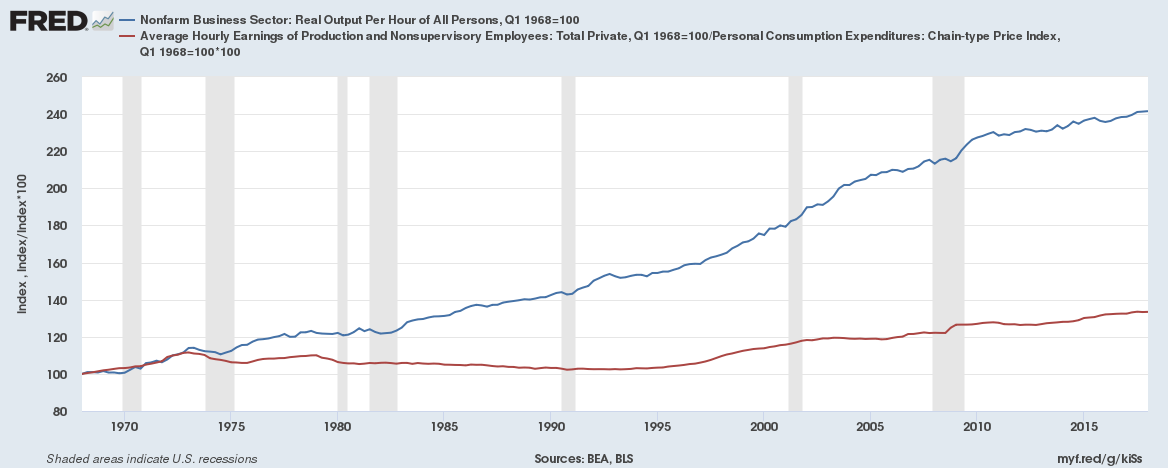
Assuming perfectly competitive markets (stop laughing!), somebody who was paid $8.60 an hour in 1968 produced at least $8.60 of value an hour in 1968. I’ll be conservative and say productivity growth has been slower for minimum wage work than work on average, so their productivity has only increased by half as much – a mere 70%. Then an hour that created $8.60 of value 50 years ago should create $14.72 today.

Or we could take another track, and ask what the minimum would be if we tried to keep it at half the average. Since hourly average wages in 2018 are 22.60, the minimum wage would be $11.30.

Monday, June 18, 2018

How Automation Will Change Management


So, for my job I do quite a bit of reading about “the future of work” and I have some opinions about how some emerging management challenges that future implies. Now the key feature of work in this future, which has been coming at us, really, since the start of the industrial revolution, is automation.  Continual progress in labor-saving devices, increasing productivity, allowing us to all enjoy a higher standard of living (at least in the long-run). And the ultimate in saving labor, of course, is automation, performing a task without any human input at all. This has been the trend since steam-power replaced muscle power. As time goes on, the easiest jobs to automate are automated away, and humans do more work that’s difficult or impossible to automate.

What’s easy to automate? Machines excel at routine and predictable tasks – anything that can be fully described in formal, logical, precise terms (“if this do that”) or are totally repetitive (“every 1.74 seconds swing downward with between 1000 and 1050 kiloNewtons of force) is, bluntly, a job perfectly suited for machines – and a job that will be automated away as soon as economical. But sorting good art from bad, understanding spoken language, driving a car – any sort of work that might at any point require a modicum of actual thought (which is quite a bit of “unskilled labor” in the service sector) is difficult or impossible to automate completely. Answering a question like “is this a good investment” is something only a human can do, even as that human uses (hopefully!) a variety of sophisticated machines to help them make that decision.

Why is all this a problem for management? Because the work that’s being automated away is also the work that’s easiest to manage. Evaluating performance is easy for predictable and routine tasks, observing effort is straightforward when the work takes place almost entirely outside a worker’s head. Traditional management techniques and organizational structures are well suited to incentivizing effort (using Motivation 1.0 and 2.0, for those of you who’ve read a certain book) and evaluating performance.

But increasingly, more and more work will take involve complicated tasks that are costly or difficult to monitor, and more of that work will take place inside people’s heads. This isn’t an insurmountable problem, but managers will have to lean increasingly on intrinsic motivation (Motivation 3.0) in order to accommodate this. And bluntly, I don’t think business leaders (or at least American business leaders) are able or willing to deal with this problem. Grappling with this problem requires a (in the American context) radical rethink of employer-employee relations; conceiving of an employment relationship a social as well as economic relationship. The fundamental human in human relationships is reciprocity – why should workers be loyal to your company and emotionally invested in its success, if the company doesn’t feel the same way about them?

The alternative response is for management to spend whatever it takes on monitoring in order to 
avoid giving up any sort of control over workers and the workplace – even if it would be costlier. 

Hopefully profits are more important to capitalists than power.

Tuesday, January 31, 2017

The Value of Innocence.

Surprisingly often, the right thing to do is the smart thing to do.

Take public defenders. Or rather, don't. Because at present in the USA the de jure constitutional right to legal representation is de facto a cruel joke, with PD's working between 1.5 and 2 time the recommended caseload, and as a result about 90% of their clients plead guilty in a plea bargain. This ins't just a miscarriage of justice, its also very wasteful.

Public defenders with 11-15 years of experience earn on average about $76,000 dollars a year, rookies about $50,000. On average, the recommend number of felony cases for them to work is about 50, and the number they actually work is a bit over 100. So how many innocent people accused of felonies do they have to successfully defend each year to pay for themselves?

One.

See, putting people in prison isn't free. It costs about $30,000 dollars on average to keep people in prison, depending on the state. Since the average prison sentence for serious crimes is about 3 years (assuming a discount rate of 3%) the present cost to the government is about $84,000. That's ignoring the wages, and taxes on those wages, that are lost keeping an innocent person in prison. If we took that into account the social cost would be much higher.

Now the key variable in all this is how often innocent people are charged with felonies. So my question to you is this, how many times out of a hundred do you think an innocent person is charged with a felony?

Lets say that its 2%. That's a very good error rate. After all, the threshold for publication in the sciences is 95% confidence. But a three percent error rate means that if public defender worked 50 cases, on average 1 would be innocent. And if he successfully defended that one innocent person he's more than paid for himself. But a public defender can't mount successful defenses unless his caseload permits it. At fifty cases per PD he could successfully defend innocent clients. At the current level, where 90% enter plea bargains, that doesn't seem so likely.

Now this accounting doesn't fully measure all the other court costs, although those would generally be incurred regardless of whether or not a person is innocent, and so are a wash. But my estimates for false charges are very conservative, which I think more that balances it out.

tl;dr Public defenders more than pay for themselves. We could double the amount of money we spend on them, and more than make it up on the reduced prison spending. But we won't do that so long as cruelty and stupidity are governing principles.